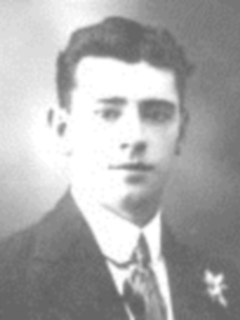
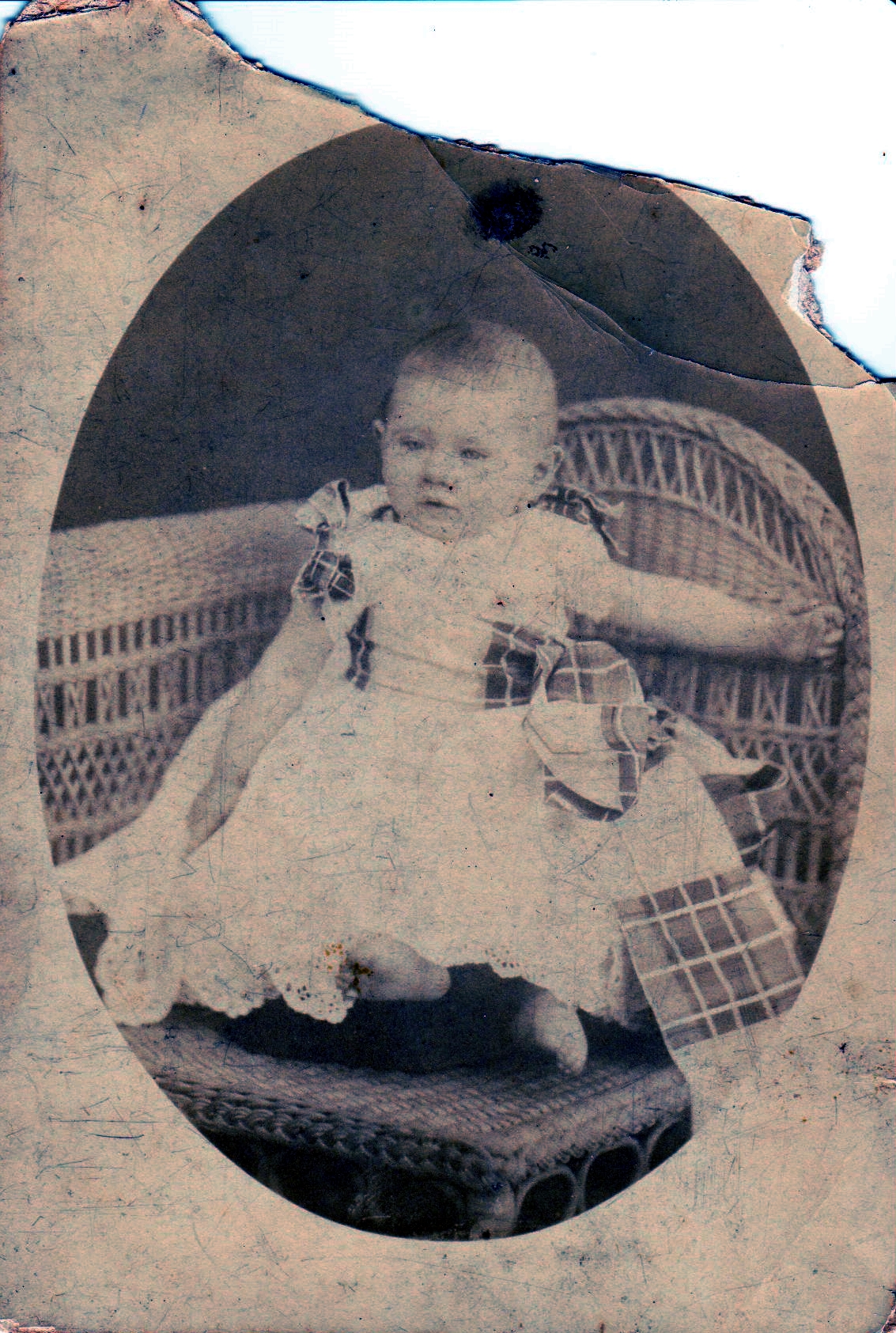
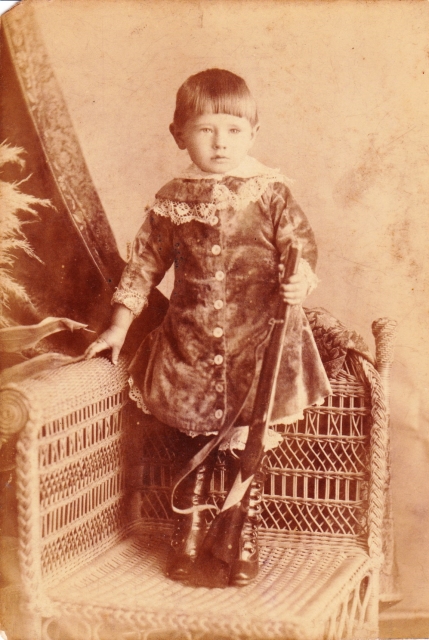
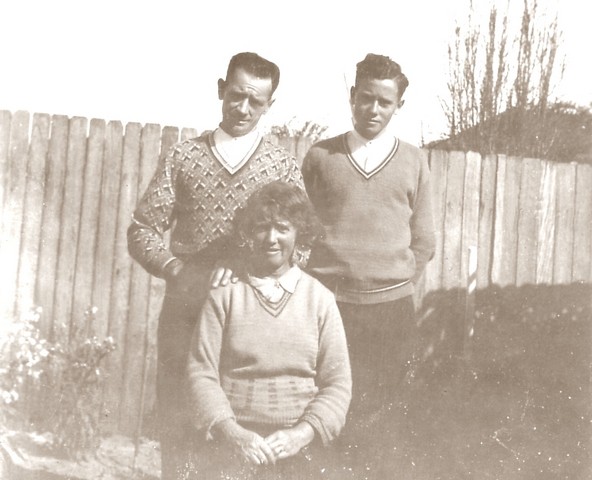
Born on the 3rd December 1888, William Alexander was the first born and only son to Thomas Baird Hannah and Jeanie Jack. He was born at 15 Halloran St, Leichardt, a suburb of Sydney. The house was and still is a small workers cottage a short distance up Lillyfield Road from where his father would have worked as a timber sawyer in the clutter of sawmills that lined Rozelle Bay in the late 1800’s.
Attending the birth were Dr. Burgoyne, and Mrs Souter who was Thomas’ sister. She and her husband Alexander were living either with or nearby to Thomas and Jeanie at the time, as her address is also given as Halloran Street. Baby William may have been named after his uncle, Alexander Souter, as the name Alexander had not previously appeared in the Hannah line.
Shortly after his birth, the family moved to 120 Foucart Street, Balmain. Foucart Street runs away from Rozelle Bay and up the hill toward Balmain. Here his sisters Agnes (1892) and Catherine (1894) were born. Three months after the birth of Catherine, their father was tragically drowned while prawnfishing off the rocks near the Gordon Street wharf in Rozelle Bay. Although there were other family members around, for six years, Jeanie would have struggled to keep her little family together. Young William and his sister Agnes would most likely have started their schooling at Balmain school.
Eventually in 1900 with the bubonic plague closing in on Balmain, Jeanie packed up her family and travelled back to her hometown of Hamilton, Scotland. Charles Burns Jnr, William’s cousin, writes of the time around her departure as follows:
“He (William Alexander Hannah) was a native of Rozelle and went home to Scotland with his mother and sister Agnes when they were very small, after their father had been drowned in Rozelle Bay. The Balmain people got up a benefit for my Aunt, and they raised 100 pound. I went with my mother to the concert.
‘It was during the bubonic plague and when we got there we were told that that part of Balmain was to be quarantined, but this did not happen till two days after. I carried Agnes who was about 3 years old aboard the ship, and didn’t she play up on the way over. The youngest Cathie got thrown out of her Bunk and broke her collarbone.”
Hamilton was a major coal mining town in the early 1900’s. Just south east of Glasgow, most of it’s population was either involved in, or dependant on the industry. The children attended the Hamilton “ragged” school as it was apparently known. In March 1901 when the census was taken, the family were living at 45 Muir Street, along with Jeanie’s parents and 21 other people. The building must have been typical of the tenement style dwellings built to accommodate the mine workers. Unfortunately most of the buildings that stood there in the early part of the 20th century have now been demolished to make way for widening of the road.
On the census returns, Jeanie recorded her occupation as “washerwoman”, surely a hard, thankless and tiresome task in a town and family of coalminers. The children were all recorded as scholars.
On the 28th of June 1901, Jeanie remarried to William Linton, a coalminer and neighbour. A daughter, Janet, or Jessie as she was affectionately known, was born in 1905.
William’s mother Jeanie died on the 3rd of July 1910.
The 1911 census for Hamilton records that he was employed at the steelworks, probably at Clydebridge.
Family legend would have us believe that the children, particularly William did not get on well with their new stepfather. Preferring the company of his uncle William and family in Paisley, William Alexander slowly migrated toward living on the west side of Glasgow, his uncle providing schooling and eventually an apprenticeship in a Glasgow shipyard. Family sources suggest that the yard may have been owned by John Baird, a relation. While this is quite possible, to date no information has been found to support the suggestion. His uncle may have also introduced him to the Masonic Lodge of which he was a Grand Master in Paisley.
A keen football (in Australia we would call it soccer) player, he is believed to have played with the Hamilton Academicals club.
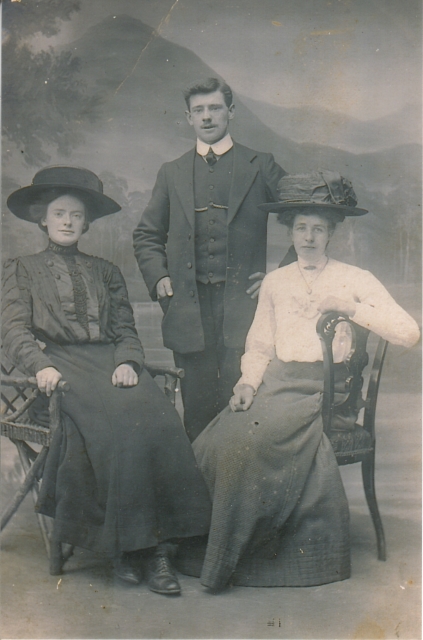
He apparently kept in touch with family members back in Australia. It is believed that William developed a romantic connection with a lady in Glasgow. A photo postcard sent to the Spalding family shows William with his sister Agnes and the “young lady I told you about”, a Miss Mary McKay. Promising to have her “brought out” to Australia, he decided to travel back to his birth country around 1912. By now he was 24 years of age, and a tradesman moulder.
Settling back into the Balmain area he had known as a child, William boarded with a Mrs Mary Henson.
He began work with the Cockatoo Island shipyard, perhaps introduced by William Spalding Jnr. who also worked there as a furnace man. His time at Cockatoo Island saw the launch of Australia’s first naval torpedo destroyers. The “River Class” Warrego was the first off the slips. She had been built at Fairfield Shipbuilding & Engineering Co Ltd, Govan, Scotland, dismantled and shipped to Sydney, then reassembled at the dockyard. Launched in 1912, she joined the Parramatta and Yarra which had been built entirely in Scotland in 1910. It is believed that William was responsible for castings, including the ship’s bell now on display at the Australian War Memorial.
By 1916, and the outbreak of World War I, her sister ships Huon, Torrens and Swan had also been launched at Cockatoo docks.
William formed a close attachment to the Spalding family. Upon the death of William Spalding Snr. several funeral notices appeared in the Sydney Morning Herald, June 16th 1913 including the following:
“Friends of the late Mr. William Spalding are kindly invited to attend his funeral to leave his late residence 30 Rosebery Street, Rozelle, this afternoon at 2 pm for Presbyterian Field of Mars”
“Friends of Mr. & Mrs. John McDonald are invited to attend the funeral of their late dearly loved uncle”
“Friends of Mr. W. Hannah are invited to attend the funeral of his late dearly loved uncle”
Although William was not strictly a nephew, he obviously claimed the title through the relationship his father Thomas had with the family, and on account of his own relationship with them.
Soon he was to meet Mrs Henson’s niece, Charlotte Martha Cox. Miss Mary McKay, now a long way away on the other side of the world, was soon forgotten. Legend has it that he sent word back to his sister Agnes, still in Scotland to “break it off” with Mary.
William became engaged to Charlotte and married her on the 12th of December 1914 at St. Pauls Presbyterian Church, Rozelle.
His father-in-law, Harry Cox, built a house for the new couple in Tennyson Road, Gladesville, where their two children, William Cox (1915) and Charles Sutton Cox (1917) were born. Charles was named after Charlotte’s brother who had been recently killed on the western front in Belgium.
At the outbreak of war, he volunteered to join up, but was refused because he was working in an essential industry.
William started a new job at Buzacott’s works in Rosebery for a while, then moved to Malleable Castings Pty Ltd in Marrickville. His supervisor there, Jack Mason, encouraged him to move house from Gladesville to a new beachside suburb. In 1923 the family moved to a new home in Garden Street, Maroubra, one of Sydney’s eastern suburbs. At the time it consisted largely of sand hills and swamps. There the children settled into a new school, and got into the kinds of “mischief” typical of boys of that age and era.
He never owned a car, and every morning would leave at 6am to catch the tram. When his son Charles purchased a car in 1938, he was able to take his father to work, allowing him to leave much later in the morning.
After work was often a time of refreshment at the White Horse hotel at Daceyville. He was generally a quiet, easy going and affable man, unless he had had a drink too many, in which case he often became louder and more talkable.
His grandchildren in later years were to be much impressed with his heavy Scots accent, which sounded so unusual and convincing to their ears. It was only in later years that they learnt he was as “Aussie” as the rest, and only used the “hoo noo brewn cew” to impress young ears.
Weekends were usually filled with fishing trips, visits to the relatives (by tram), and the occasional show at the Prince Edward movie theatre. He was not a bad singer by most measures, and evenings would be spent around the family piano, Charlotte at the keyboard. William’s favourite was probably “Little Town in the Old County Down“, sung with much gusto.
Holidays were invariably taken at the Cox family weekender at Booker Bay, Woy Woy, where time was spent fishing, and cleaning fish, and fishing, and cleaning…..
Both sons served in the Second World War, and also married and moved away from the family home, William to Marrickville and then Kingsgrove, and Charles to Peakhurst, followed by another move with his young family to northern New South Wales.
Charlotte and William came to visit once, Grandma deciding that life in the bush was not for her, and never returning. She died on the 26th of April 1956 at the age of 70.
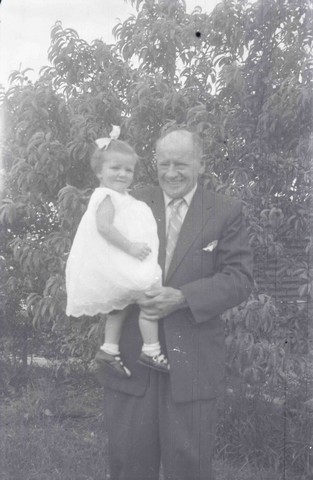
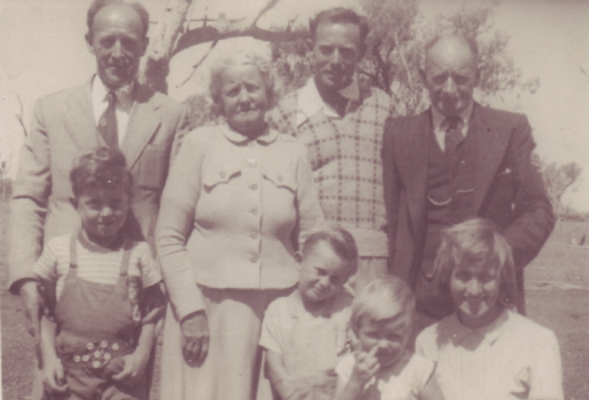
William became a regular visitor to the family farm. Helping out with all the work to be done and mingling with the neighbours were his favourite pursuits. A new daughter for Charles and Sylvia was born shortly after Grandma Charlotte’s death. Named Charlotte Janet after both grandmothers, she became the apple of William’s eye, a much loved granddaughter, and a good reason to come and visit in the bush.
He was a keen member of the Masonic Lodge Waratah, and together with son William progressed through all the chairs, to the position of Master. He was also a keen member of Manchester Unity of Oddfellows in which he also held a high office.
William died on the 7th of December 1962 aged 74 years, at the “House of Peace” Nursing home in Marrickville. His cause of death cancer. He was buried at the Cox family grave at the Field of Mars Cemetery, Ryde, Plot 234-237 in the Presbyterian Section, Row 10.